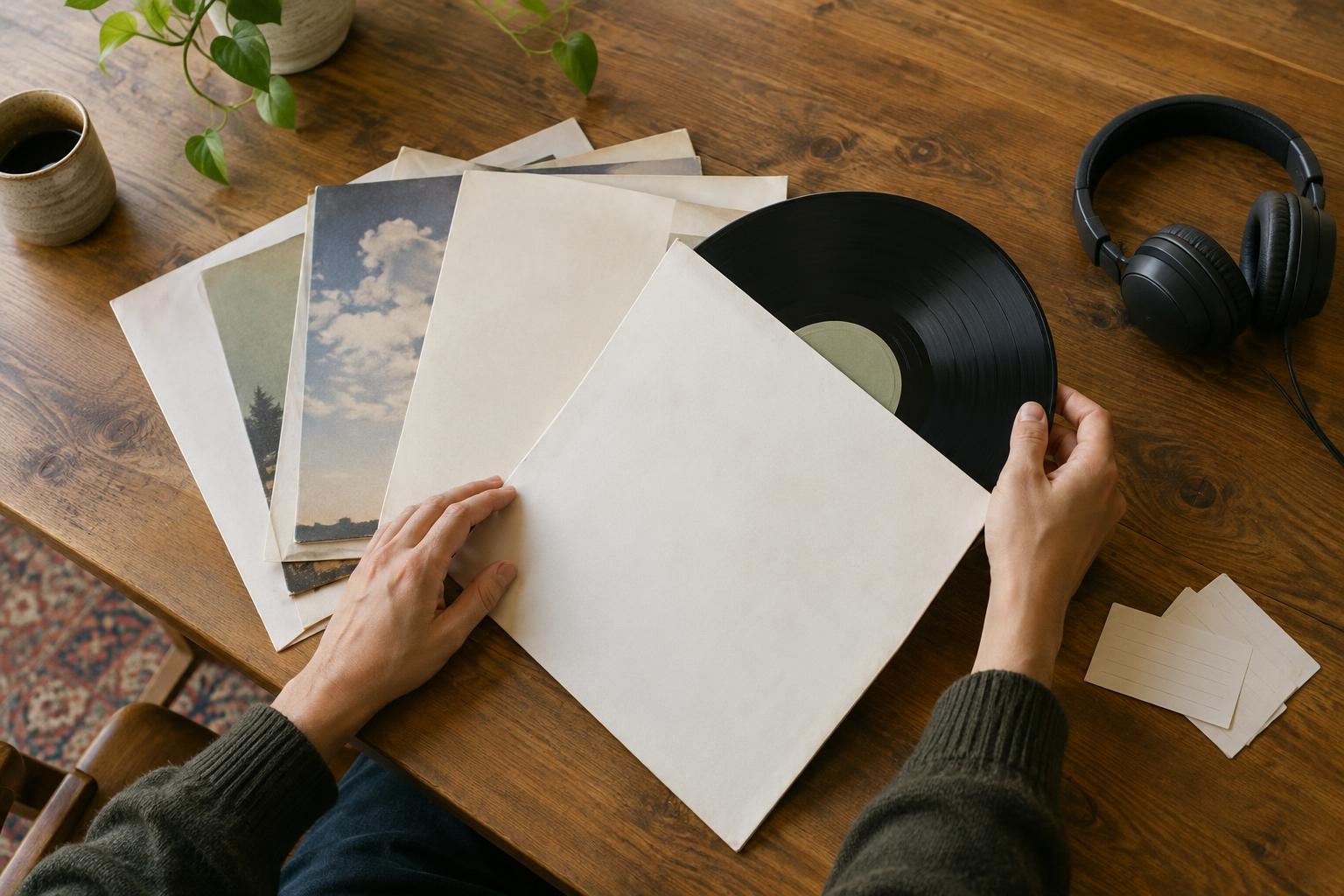
Choose an entry point
An independent record label’s catalog can look like a stack of unrelated releases at first. It may include albums, short releases, compilations, collaborations and reissues made across different periods. You do not need to hear everything in order to understand what makes the label interesting. Start with one release that gives you a reason to listen: an artist you recognize, a cover that catches your eye, a description that names a sound you enjoy, or a compilation that brings several artists together.
If the catalog is large, make the first choice small. Pick one album and one contrasting release, such as a single or compilation track. This gives you a point of comparison without asking you to judge the whole label at once. Release dates and catalog numbers can help you navigate, but they do not tell you which record is best. Treat them as signposts rather than a required listening order.
Listen for connections, not a single house sound
A label may have a recognizable identity, but that identity is not always a genre. It might come through in production choices, adventurous sequencing, artwork, collaborations or the way releases make room for unusual voices. As you listen, notice what carries across records and what changes. Are the recordings intimate or expansive? Do tracks leave space for improvisation, or build around tightly shaped songs? Which releases surprise you?
Give each selection enough time to reveal its own approach before comparing it with the next. A quick sample can tell you whether to keep listening, but a full track—or an album played in sequence—may show how an artist handles contrast and pacing. If a release does not connect with you, move on without treating that response as a verdict on the catalog. Discovery works better when curiosity has room to change direction.
Follow the people behind the releases
Credits can turn a catalog into a network. An artist might appear first as a guest performer, then as a band member or solo musician. Producers, engineers and visual artists may also work on multiple releases. Following one name across the catalog can reveal a more personal path than scrolling through every title in order.
Compilations are useful for this kind of exploration because they place different artists side by side. When a track stands out, find the artist’s other releases, then look at the musicians they work with. If the label provides notes or artist descriptions, read them as context rather than instructions for what you should hear. A useful question is not only “What sounds similar?” but also “What changes when this person works with someone else?”
Use the catalog’s structure as a guide
Many catalogs offer more than a list of albums. Format labels, series names, release notes and artwork can help you decide where to go next. A series might gather experiments that sit apart from the label’s main releases; a reissue may point toward music that influenced its later output. These clues are worth exploring, while remembering that not every label organizes or describes its work in the same way.
Try a simple route through three releases: one early title, one from a later part of the catalog and one chosen purely because it interests you. Listen for continuity, but do not force a tidy story of progress. A label’s direction can shift as artists join, leave or pursue new ideas. The goal is to find promising paths, not to prove that every release fits a single narrative.
Keep a trail you can return to
A few notes make future listening easier. Record the title, the artist and one detail you want to remember: a rhythm, a lyric, a recording texture or a name in the credits. Mark releases you want to revisit separately from those you have not heard yet. That small distinction prevents a discovery list from becoming an intimidating backlog.
When something stays with you, return to it before adding more. Repeated listening can make a quiet track more rewarding than one that seemed immediately striking. You can also share a specific recommendation with a friend—what caught your ear and who might enjoy it—rather than simply sending a long list. Exploring a catalog is not a completion challenge. It is a way to let one good find lead, at your own pace, to another.