Start with one promise to the listener
Before you list talking points, finish this sentence: “By the end of this episode, you’ll be able to…” The answer gives your episode a destination. A topic such as “home recording” is broad; “choose a quieter spot to record a first voice memo” is something you can explain and demonstrate. A narrow promise helps you decide what belongs in the episode and what can wait for another one.
Write that promise at the top of your outline, followed by the listener’s likely starting question. If your episode is about keeping a music-discovery journal, the question might be, “What should I note after hearing a new song?” Your job is not to answer every question about music listening. It is to move the listener from that first question toward a useful next step.
Build a route, not a transcript
Divide the main idea into three or four stops that follow a natural order. For a music-discovery journal episode, you might cover what to capture on a first listen, what to notice on a second listen, and how to revisit your notes later. Give each stop a short heading and one sentence explaining its purpose. If two stops do the same work, combine them; if a stop needs a long explanation to justify its place, consider leaving it out.
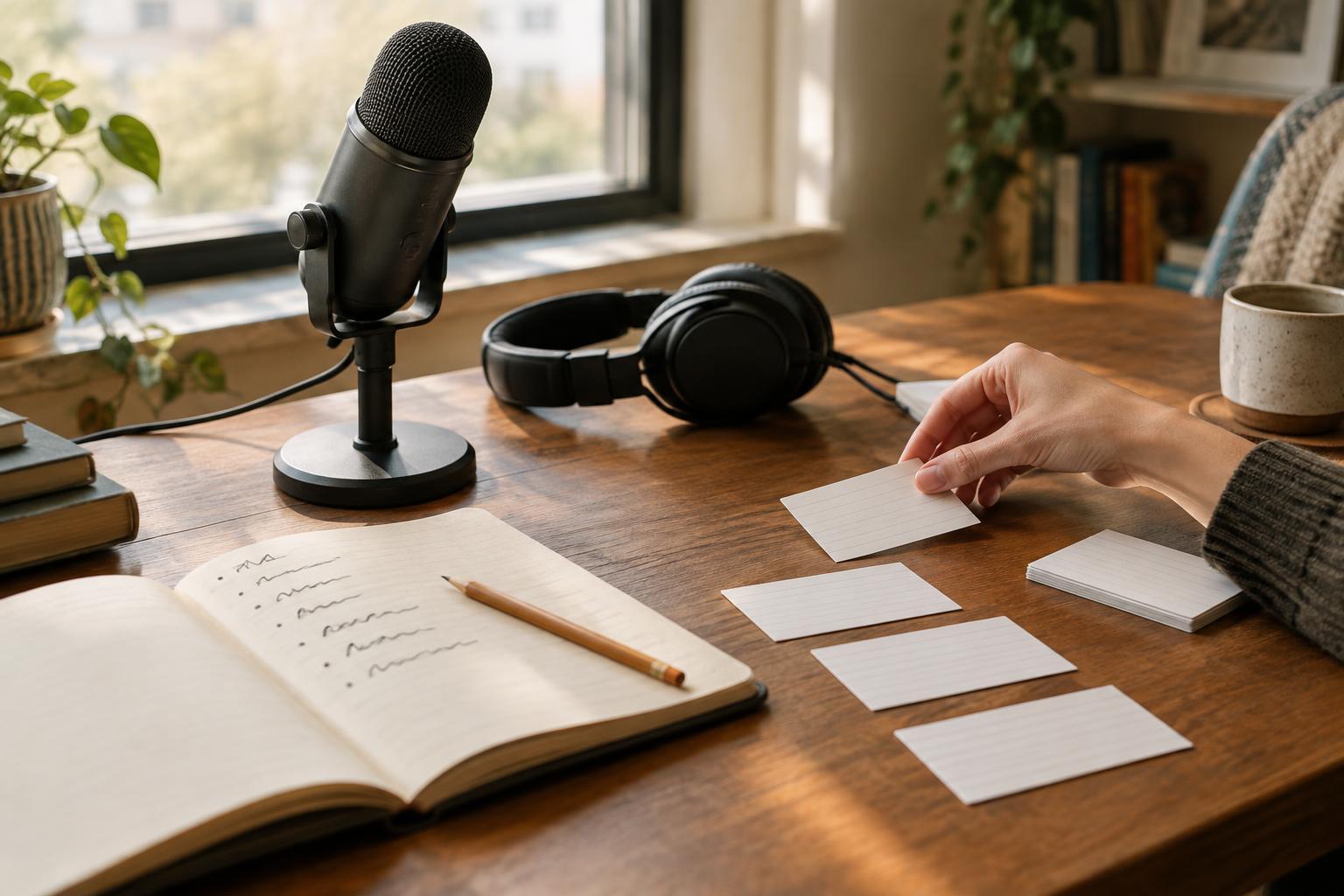
Under each heading, add only the details you are likely to forget: a specific example, a question to ask aloud, or a point that needs careful wording. You can mark a personal story with a few cues, such as “bus ride, unfamiliar rhythm, changed my mind,” rather than writing the story in full. Those cues preserve the sequence while allowing you to tell it naturally when you record.
Plan the opening and transitions
A solo episode can feel harder to follow when the speaker changes direction without signaling it. Sketch an opening that names the question, says why it matters to the intended listener, and previews the route. You do not need a dramatic hook. A direct line such as “Today I’ll show you a simple way to keep track of songs you want to return to” tells listeners what they have chosen to hear.
Then add a transition cue between stops. It might be a question: “Once you have a first impression, what is worth noticing on a second listen?” Or it might connect two ideas: “Those quick notes are useful now; here is how to make them useful next month.” Put the cue in your outline, not necessarily its exact phrasing. When recording, use it to remind yourself why the next section follows.
Write out only what needs precision
An outline is flexible, but some lines benefit from being written in full. Script a definition if a loose explanation could confuse listeners. Write down a name, title, or technical term you want to say accurately. If you are inviting listeners to try an exercise, note its steps in order. You may also want a prepared closing sentence that brings the episode back to its original promise.
For everything else, use prompts rather than polished prose. Instead of a paragraph explaining how to compare two recordings, write “playback comparison: same headphones, comfortable level, what changed?” If you need to make a qualification, include it as a cue too: “room choice helps, but cannot fix every recording problem.” These small reminders support accuracy without requiring you to perform a page of written text.
Test the outline aloud and leave room to edit
Read through your outline as though you were recording. Do not aim for a perfect take; listen for places where you run out of things to say, repeat yourself, or struggle to explain how one point leads to the next. Add a concrete example where an idea feels thin. Cut a point if it distracts from the promise. If the route feels crowded, keep the strongest stops rather than rushing through all of them.
During recording, your outline is a map, not a rulebook. Pause when you need to find a thought. If you say something more clearly on a second try, you can remove the first version when editing. Keep the outline nearby as a way back after a tangent, and end by giving the listener a small action related to the episode: for example, make three notes after the next new song they hear. That clear finish matters more than delivering every planned sentence.