Why the distinction matters
A close microphone, footsteps, and a confident narrator can place a listener inside a scene. That intimacy is one of audio storytelling’s strengths, but it can also blur an important distinction: are we hearing an event as it happened, someone’s memory of it, or a version assembled later to help tell the story? Listeners cannot inspect an audio scene the way a producer can inspect a timeline. Give them enough context to understand what each sound and statement represents.
Clarity does not require a warning before every sentence. It means choosing language and sound that match the strength of the material. A dated recording, a person recalling an evening years later, and an actor reading words from a script can all belong in one story. They should not all be presented as though they carry the same kind of certainty.
Name the basis for each important claim
Before writing a scene, sort its key details into three working groups. Known details are supported by material you can identify, such as an original recording, a message, or accounts that agree on a point. Remembered details come from a person describing their own experience; they may be vivid and valuable without being exact. Reconstructed details are choices made during production, such as a condensed sequence, a newly recorded line, or an imagined background sound.
Then let the narration do some quiet labeling. Compare “The door slammed, and everyone went silent” with “Mara remembers a door slamming. What stayed with her was the silence afterward.” The second version tells us whose experience we are hearing without dismissing it. For a supported detail, a brief cue may be enough: “In the recording from that afternoon, you can hear the door close.” If accounts differ, say so where the difference matters rather than smoothing it into one definitive scene.
Make reenactments audible as reenactments
Reconstructed scenes can help listeners follow a sequence that was never recorded. Introduce the device before it begins: “We’ve recreated this exchange from their later recollections,” or “An actor is reading the words from a message.” If the dialogue is paraphrased rather than taken from a record, say that too. A label at the end may arrive too late; by then, the listener has already pictured the scene as evidence.
Sound design deserves the same care. A newly recorded train ambience can establish a setting, but it should not quietly stand in for a recording of the train a speaker actually took. Consider using a different sonic texture for recreations, and pair it with a plain spoken cue. Avoid adding precise sounds, such as a shouted name or a distinctive alarm, merely because they make a scene more dramatic. Specific sounds can imply specific events.
Write memory as memory, not as a flaw
People often remember the feeling of a moment more clearly than its order or exact wording. An interview can preserve that perspective without treating it as a transcript. Phrases such as “I remember thinking,” “as she recalls it,” and “he isn’t sure whether this happened before or after the call” give a listener useful bearings. They also leave room for a speaker to be candid about uncertainty.
During editing, watch for accidental upgrades in certainty. A guest may say, “I think it was raining,” while a later narration says, “Rain was falling.” A pause may be removed so tightly that a hesitant recollection sounds firm. Check transitions, voice-over, and promotional excerpts against the original wording. If a detail is essential to understanding the story but remains uncertain, explaining the uncertainty is usually more informative than hiding it.
Give listeners a consistent path through the story
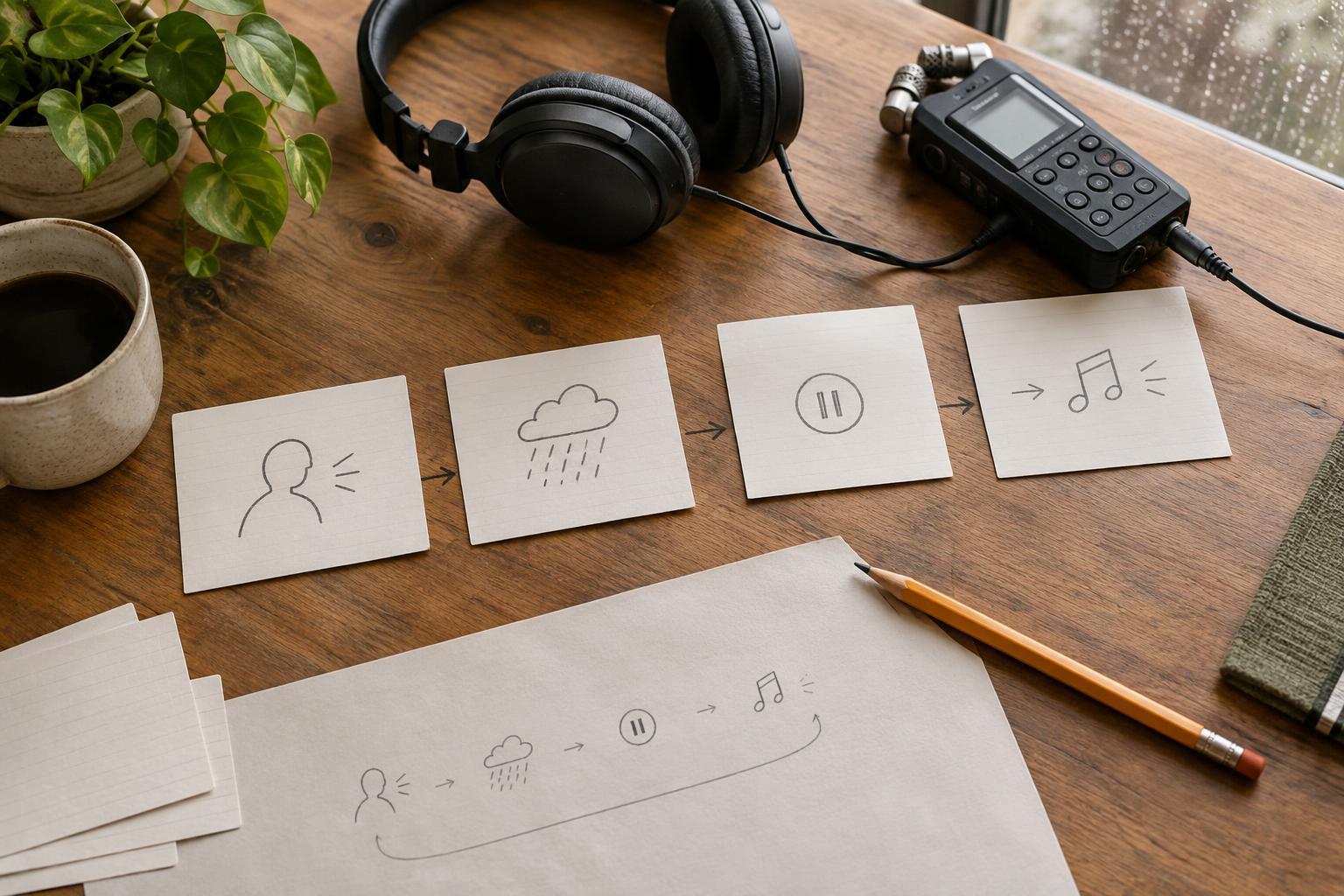
You can establish a simple vocabulary early: “When you hear the original tape, we’ll say so. Other scenes are based on interviews.” Return to a label when the story changes mode, particularly after music or a long scene. This is more useful than relying on a single production note that a listener may miss. Keep the cues short and natural so they guide attention rather than halt it.
Before publishing, listen once without looking at your script. At every scene, ask: What would I believe I am hearing? Could I tell when a voice is an actor, when a sound was recorded later, and when a person is speaking from memory? If the answer is unclear, revise the cue or the sound. The goal is not to drain a story of atmosphere. It is to let listeners enter the scene while still knowing how it was made.