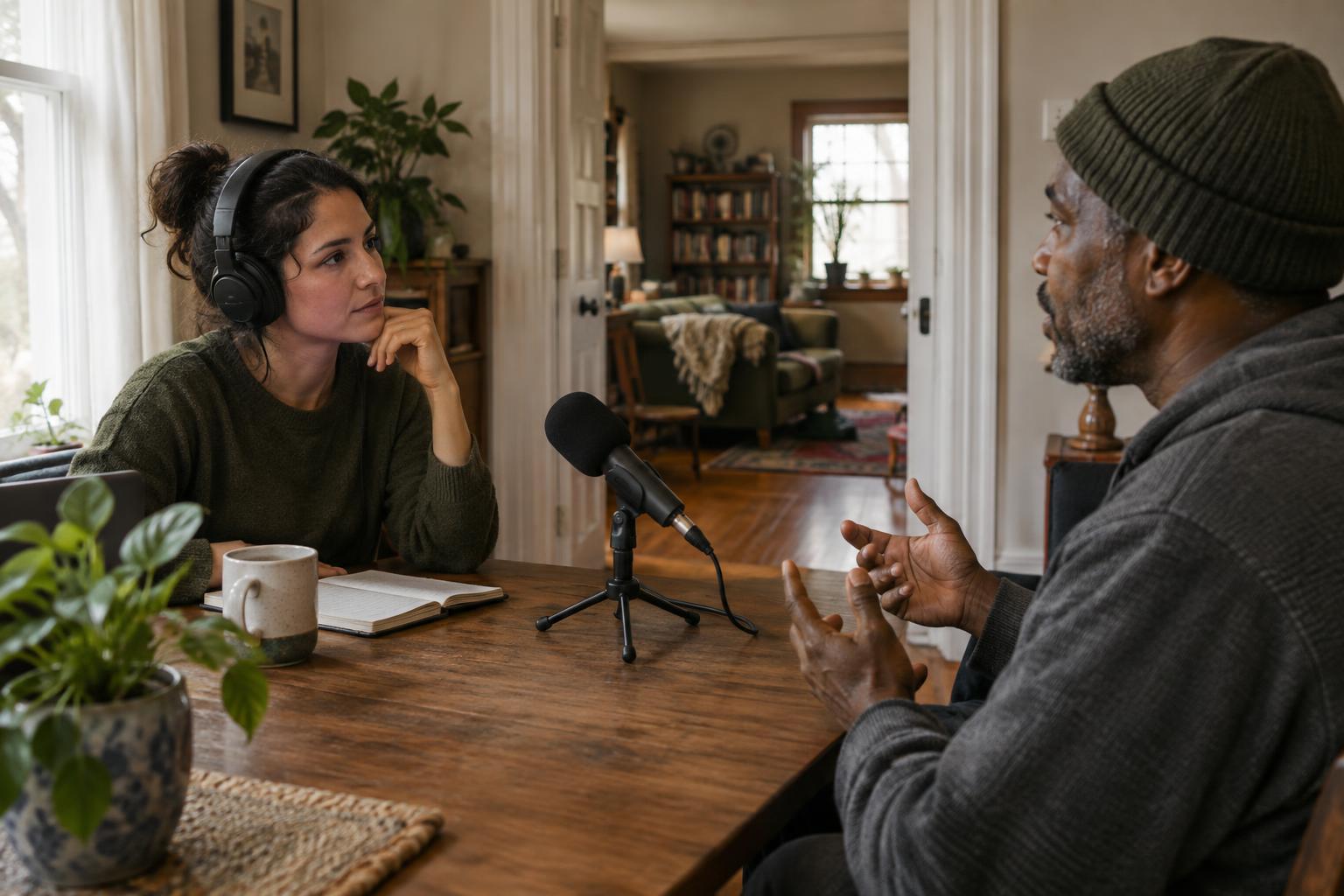
A story gives listeners a question to follow
An audio piece can be informative, moving, and beautifully recorded without being a story. A story offers a question that carries listeners forward: Will the neighborhood choir find a place to rehearse? Why did a musician stop performing, and what might bring them back? The question need not be dramatic. It needs to matter to someone in the piece and invite the listener to notice what happens next.
Before editing, try describing your story in two sentences. Name the person or group at its center, what they want or need, and what makes that uncertain. If the description is only a topic, such as “a local choir,” look for a more specific thread. You can still include background and context, but they work best when they help listeners understand the question rather than interrupt it.
Scenes let us hear events unfold
A scene places listeners in a particular moment. Voices interact, an action takes place, and the sound around it helps establish where we are. A choir member describing a difficult rehearsal can be valuable; hearing the group pause, try a passage again, and react to the result gives listeners a different way to understand the effort involved. Neither approach is automatically better. A strong audio story often uses both lived moments and reflection.
Build a scene around an action the audience can follow. Establish who is present and what they are trying to do, then leave room for the moment to develop. Use narration when a transition or an unfamiliar sound needs clarification, not to repeat everything the recording already conveys. Record enough room tone and surrounding sound to make edits intelligible, but avoid adding atmosphere that suggests an event happened differently from how it did.
Change gives each scene a purpose
Not every story needs a dramatic reversal. Change might be a decision, a newly understood obstacle, a shift in someone’s confidence, or a clearer view of a relationship. In the choir story, an early scene might show members expecting an easy rehearsal. A later scene could reveal that the new space makes it hard to hear one another. The group then has to adjust its plan. That movement gives the scenes a reason to appear in that order.
When choosing material, ask what listeners know or feel after a scene that they did not know or feel before it. If two scenes do the same job, consider keeping the more revealing one. Interviews can show change too: a person may reconsider an earlier assumption or explain why a choice now feels different. Keep that development faithful to what they said. Editing for pace should not turn uncertainty into certainty or make disagreement disappear.
Resolution answers the story’s question honestly
Resolution is not the same as a happy ending. It is the point at which the central question has been answered as far as the reporting allows. Perhaps the choir secures a rehearsal room, decides to meet outdoors instead, or remains unsure while learning what matters most to its members. Any of these can make a satisfying ending if the piece has prepared listeners to understand the outcome.
Look back at the opening question before selecting your final scene. Does the ending show what changed, and does it leave genuine uncertainty intact? A reflective interview line may work, but an action can sometimes carry more weight: members stacking chairs after a rehearsal, already discussing where they will meet next. Give listeners enough context to interpret the moment without telling them exactly what to feel.
Shape the listening journey
Audio moves at the pace you set, so orientation matters. Identify speakers when their voices might be confused, signal meaningful changes of place or time, and introduce necessary background close to the moment it becomes useful. A simple outline can help: opening question, scenes that complicate it, a turning point, and an ending that addresses it. This is a guide for editing, not a rigid formula; a quiet story may need only a few carefully chosen moments.
On a final listen, pay attention to where your curiosity rises or fades. If a sound is striking but does not advance the story, shorten it or give it a clearer role. If a crucial decision happens off-mic, explain what you can verify rather than inventing a scene around it. The aim is not to make real life seem tidier than it is. It is to help listeners follow people through an experience and understand why the experience matters.